
A new rule has taken hold in America’s C-suites: speak up, and you become a target. More than half of US communications chiefs say their company went quiet over the past year on issues it would once have taken a clear stand on. In Europe, the figure is 28%. That is the finding of the Ipsos Reputation Council Report 2026. For US companies, it is only half the challenge – because across the Atlantic, skepticism is growing toward anything that looks “too American.”
Key Takeaways
- Silence as the default: 53% of US communications chiefs say their company has stayed quiet over the past 12 months on issues it previously would have spoken out about. In Europe, the figure is 28%.
- Better quiet than exposed: 71% of US respondents would rather stay quiet on potentially divisive issues, compared with 55% in Europe.
- Pressure from two directions: Federal policy and executive orders keep shifting the rules, while individual states such as California are introducing new disclosure requirements.
- America loses its shine: According to Ipsos, there is now a penalty in Europe for being perceived as “too American.”
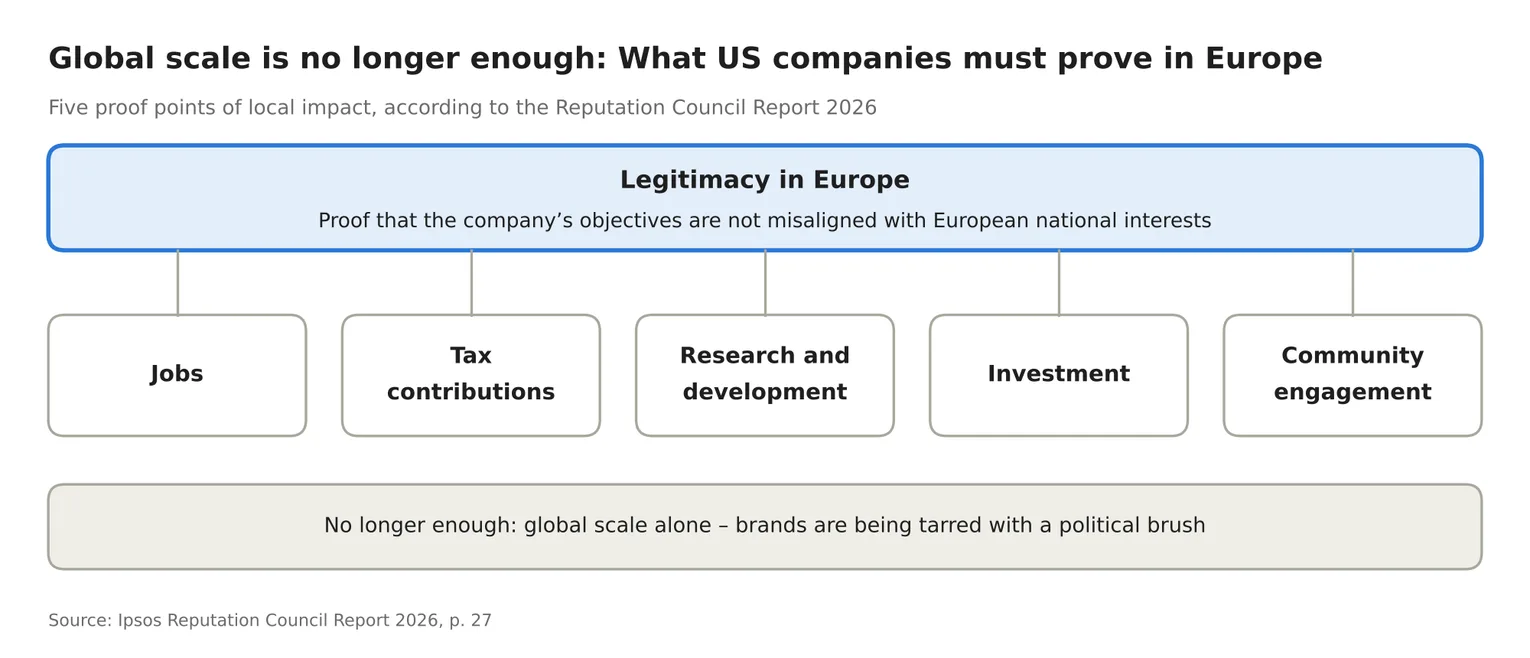
- Legitimacy as the new currency: In Europe, US companies must demonstrate local impact – through jobs, taxes, research, investment and community engagement.
A Forum for the World’s C-Suites
Ipsos, the market research firm, established its Reputation Council in 2009. For the nineteenth edition, published on October 13, 2026, under the title “Life After Predictability,” Ipsos conducted in-depth interviews between March and June 2026 with 200 communications and corporate affairs leaders across 21 markets. The named participants include executives from numerous US corporations, among them Amazon, AT&T, Bank of America, IBM, Mastercard, Target and Wells Fargo.
The figures are self-reported. They do not show what the American public thinks – they show how the people responsible for the reputations of the world’s largest companies make decisions. That is precisely what makes them valuable.
The Number That Stands Out: 53 vs. 28
Globally, 35% of the communications chiefs surveyed say their company has recently stayed quiet on issues it previously would have addressed. That average, however, masks a deep divide. In the US, the share is 53%; in Europe, 28%. The underlying attitude is just as telling: 71% of US respondents would rather stay quiet on potentially divisive issues, even when their company could authentically speak up. In Europe, 55% say the same.
Graphic 1: Strategic silence in the US and Europe
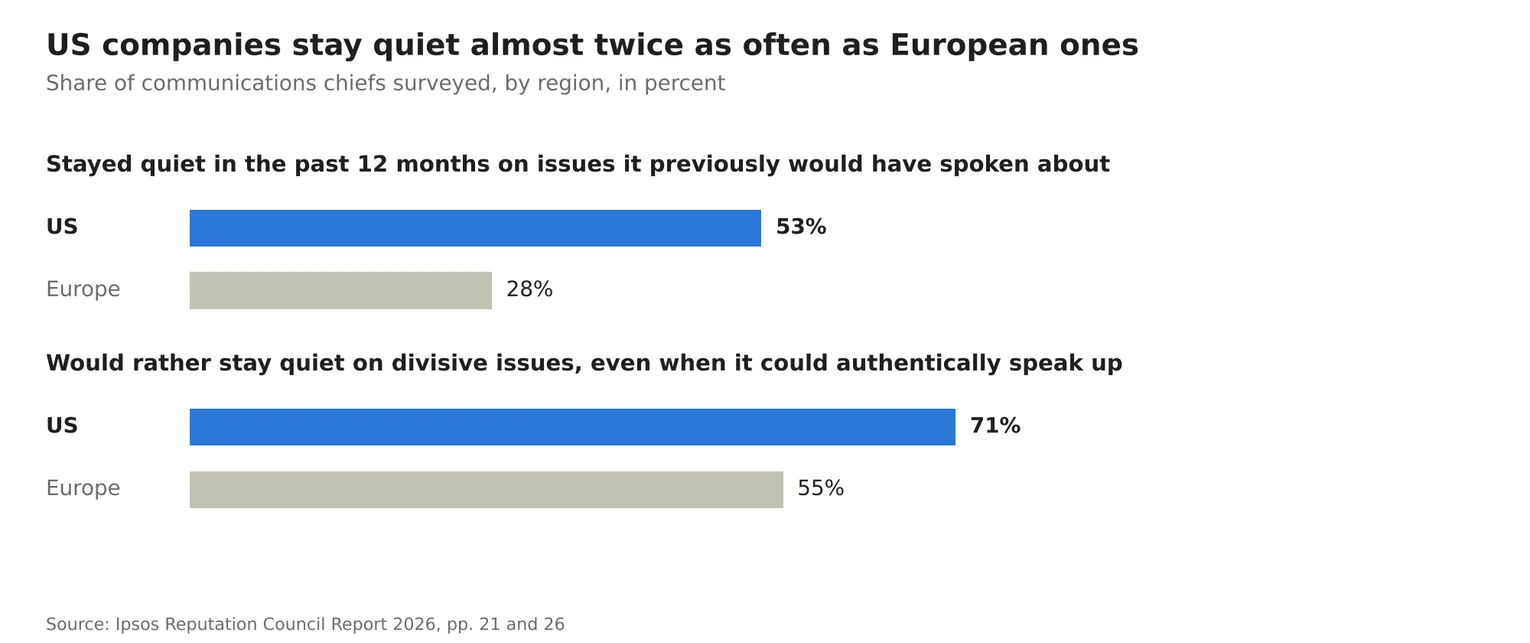
Ipsos draws a clear conclusion: strategic silence is a global phenomenon, but it is shaped by very different political contexts. One Council Member sums it up in a single sentence: “When you speak up, a target is on your back.”
Why the US Plays by Different Rules
In the United States, sustainability, DEI and ESG remain politically contested subjects. According to the report, shifts in federal policy can rapidly alter the communications landscape. One participant says their company had to take account of the executive orders related to DEI. What changed, above all, was how the company talks about what it does. Another notes that the word ESG became politicized and that everyone has since moved to “sustainability.”
At the same time, some states are moving in the opposite direction. The report cites California’s SB 253, which is forcing thousands of companies into mandatory emissions reporting. For CEOs, that means restraint is rewarded at the federal level while transparency is demanded at the state level.
The tension is most visible inside companies themselves. “Half our employees agree with the [US] administration and half our employees don’t,” one Council Member is quoted as saying. “We’re operating in a no-win situation.”
Quieter Does Not Mean Inactive
Pulling back from public debate does not necessarily mean pulling back on substance. Several respondents stress that their goals have not changed – only the way they talk about them. One participant says restrictions in the US on companies prioritizing DEI have not changed their conviction, but the company has become very outcome-oriented.
Internally, the silence does not apply anyway. One participant reports that the strategy of silence applies strictly to external communication; internally, “it is a completely different story.” Many communications chiefs therefore make a point of explaining to employees that a quieter public profile does not signal a retreat from existing commitments. That is also a matter of trust: according to the IC Index 2026 from Ipsos Karian & Box, trust in leadership teams and CEOs has fallen by nine points compared with 2025.
The End of American Exceptionalism?
For US companies with business in Europe, a second development carries at least as much weight. Several European Council Members describe a shift in attitudes toward American companies and brands. For a long time, they were seen as aspirational across much of Europe. Today, quantitative Ipsos research among consumers points to a penalty for being perceived as “too American.”
The report cites political volatility, tariffs, technology dominance and wider geopolitical concerns as the reasons. Brands are being tarred with a political brush over which they often have little control. In Europe and the UK, there is also growing anxiety about reliance on US technology, including digital payment systems, cloud infrastructure and AI platforms. Questions that once focused on innovation now also encompass resilience, dependency and strategic autonomy.
Ipsos states the consequence plainly: global scale alone is no longer sufficient proof of legitimacy. US companies must demonstrate in Europe that their objectives are not misaligned with European national interests.
Graphic 2: What US companies must prove in Europe
Two Worlds, One Corporate Narrative
The era of the “borderless” global corporate narrative is over, the report states. According to Ipsos, headwinds are coming from the US – on tariffs, through political polarization, the pushback on sustainability and foreign adventurism. Europe, by contrast, is leaning into free trade, stronger support for sustainability and multilateral cooperation. In Europe, despite simplifications, the architecture of mandatory, audited sustainability disclosure remains in place. One participant says that regulations such as the CSRD have pushed compliance “right up the agenda.”
For multinational corporations, this means the same action can earn praise in one market and criticism in another. “To act in one way in one geography can then create a vulnerability in another,” says one Council Member. Ipsos therefore describes corporate communications as an instrument of geopolitical risk management. Headquarters sets global guardrails and an overarching purpose; regional teams need extensive autonomy to navigate their specific political minefields.
Analysis: What CEOs Should Take Away
The report is not a playbook for courage. It describes how the communications chiefs of the world’s largest companies are coping with an environment in which every position draws objections. For boards with transatlantic business, three conclusions stand out.
First: silence is a decision and should be made as one. Ipsos cites a criterion that offers guidance: if an issue touches one of the company’s core principles, speak up without hesitation. If it is merely an opportunity for positioning, weigh the risks carefully.
Second: staying quiet does not make a company disappear. According to a McKinsey estimate cited in the report, roughly half of all online searches now involve AI-generated responses. Large language models assemble a company’s image from everything that is publicly available – including criticism and third-party commentary.
Third: in Europe, substance counts for more than size. The report puts it in a nutshell in the closing line of the chapter: in 2026, the most successful global companies are those that know exactly when to speak, where to localize – and how to let their actions do the talking.
FAQ
What is strategic silence? Strategic silence describes companies’ deliberate decision not to speak out publicly on politically divisive issues. According to Ipsos, 61% of the communications chiefs surveyed worldwide prefer this restraint.
How big is the gap between the US and Europe? 53% of US communications chiefs say their company recently stayed quiet on issues it once addressed, compared with 28% in Europe. On the general preference for silence, 71% in the US compare with 55% in Europe.
Why do US companies stay quiet more often? The report points to a highly charged political climate in which sustainability, DEI and ESG are contested, and to shifts in federal policy. At the same time, individual states such as California are introducing new disclosure requirements.
Have US companies abandoned their DEI and sustainability goals? Not fundamentally, according to the communications chiefs surveyed. Many are sticking to their goals but communicating more quietly and with a stronger focus on outcomes.
What is the “too American” effect? Quantitative Ipsos research suggests that companies in Europe pay a reputational penalty when they are perceived as “too American.” US companies therefore need to demonstrate their local contribution.
How can US companies establish legitimacy in Europe? The report names jobs, tax contributions, research and development, investment and community engagement. According to Ipsos, global scale alone is no longer enough.
Sources and Notes on the Data
- Ipsos: The Reputation Council Report 2026 “Life After Predictability”, published October 13, 2026. Figures and quotes are taken from the PDF report, mainly pp. 19–27 (Stakeholder Fragmentation, US-EU Tensions). Direct quotes are reproduced as they appear in the report; paraphrased statements are marked as such.
- Methodology according to the report: 200 in-depth interviews with communications leaders, March to June 2026, 21 markets. The report does not state the number of US respondents.
- Third-party sources cited in the report: Ipsos “Impacts of Multinational Corporations” 2026 (“too American” penalty), IC Index 2026 by Ipsos Karian & Box (decline in trust), McKinsey AI Discovery Survey 2025 (searches with AI-generated responses).
- Note: on SB 253, the report reads “mandatory missions reporting” – this evidently refers to emissions reporting and has been rendered accordingly.
- The US corporations named appear in the report’s list of participants. Quotes in the report are anonymized and cannot be attributed to any company.