
A six-meter-tall rotor. A $45 million valuation. An entry point of roughly $500.
U.S. energy-storage startup Qnetic is opening its latest financing round to individual investors. But the story is bigger than another crowdfunding deal. The real question is what investors are actually buying when the technology, market and business model have yet to prove themselves at scale.
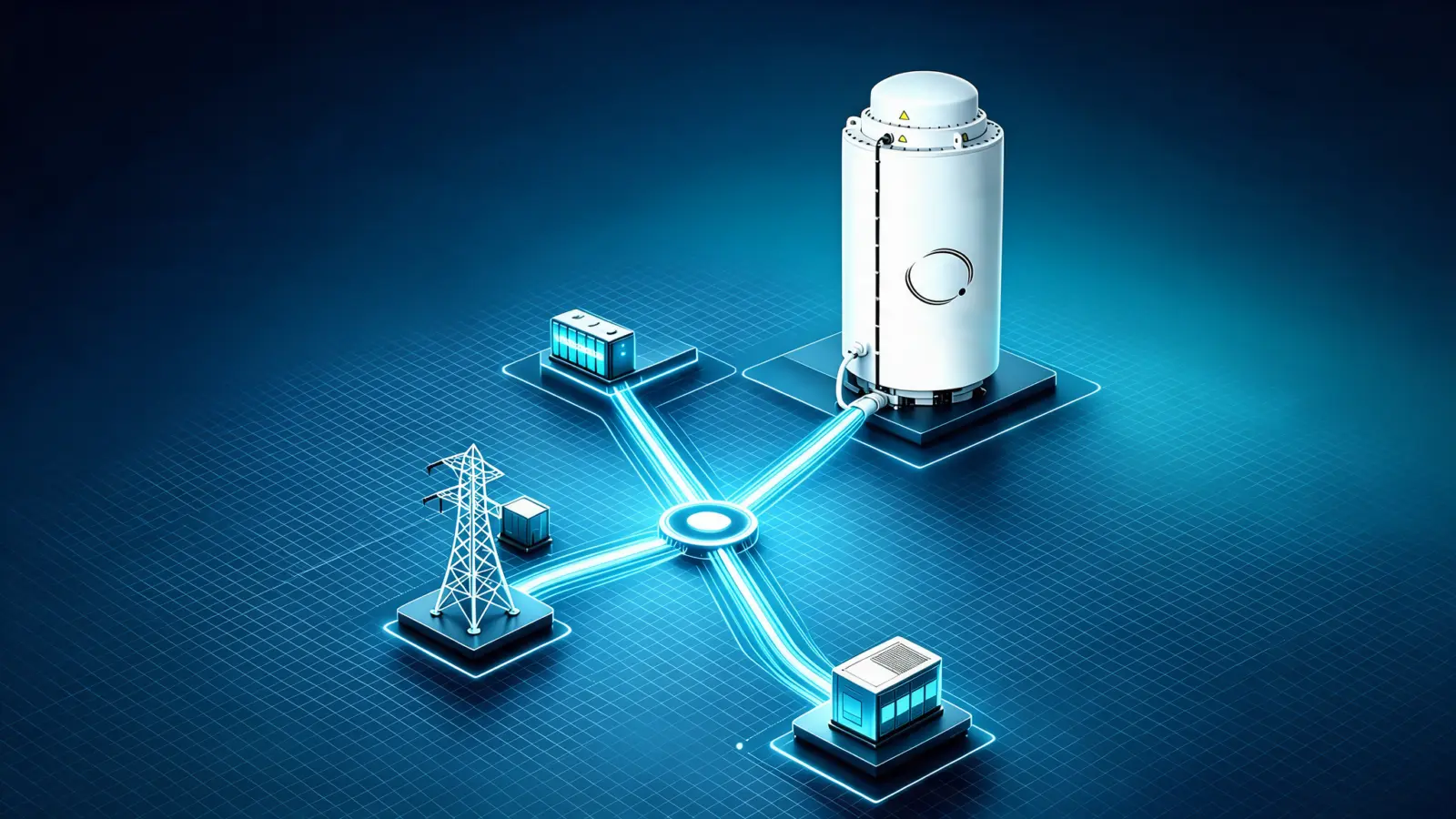
The machine Qnetic plans to bring into series production in Sacramento stands roughly six meters tall. Inside, a carbon-fiber rotor spins in a vacuum on magnetic bearings at a peripheral speed of around Mach 3.
The system stores electricity not as chemical energy, but as motion. When power is needed, the motor switches into generator mode, slowing the rotor and feeding electricity back into the grid. No lithium. No cobalt. No battery cells. And, according to the company, even after 20 days of idling, the system retains nearly 50% of its stored energy.
The underlying physics is hardly new. The ambition is. Qnetic wants to take the flywheel concept and scale it into a utility-grade energy-storage system.
“Most historical flywheel storage is like a sports car—high performance, limited utility,” says Qnetic co-founder and CEO Michael Pratt. “What we’re designing is more like a tractor-trailer with enormous storage capacity, built for the long haul.”
Getting there requires capital. And Qnetic is raising some of that money not from a traditional venture-capital fund, but from individual investors through the U.S. Regulation Crowdfunding framework, or Reg CF.
That makes Qnetic an instructive case study in an investment category that remains unfamiliar to many Americans: buying equity in an early-stage private company through a crowdfunding offering.
From Backer to Shareholder
Crowdfunding no longer means simply preordering a product.
In reward-based crowdfunding, a backer pays today for something that will be produced and delivered later. In crowdlending, investors lend money to a company in exchange for interest and repayment. Equity crowdfunding is different: investors acquire an ownership stake in the business itself.
That distinction changes the investment equation.
Someone investing in Qnetic is not buying an energy-storage system. They are buying into a company whose value ultimately depends on whether its technology can become commercially viable.
An investment opportunity that was once largely available only to professional investors is becoming accessible to individuals. But the access cuts both ways. So does the potential for significant appreciation—and the possibility of losing the entire investment.
A Machine for the Energy Transition
What Qnetic Has Already Built
Qnetic was founded by Michael Pratt and Loïc Bastard. Their starting premise is straightforward: the energy transition does not necessarily suffer from a lack of renewable electricity. The problem is having that electricity available when it is needed.
That makes energy storage critical to the transition.
Unlike many early-stage startups, Qnetic can point to tangible assets beyond a pitch deck. Its 200-kilowatt-hour Alpha prototype has been built and is operating, with functional and safety testing underway.
The company has filed four patent applications—two covering the architecture of its magnetic-bearing system, one covering the rotor and one covering the suspension system.
The hardware presented another problem: Qnetic could not find an outside testing facility that could handle a system of this size and energy capacity. So the company built its own test cell – now believed to be the world’s largest of its kind.
What began as a constraint could eventually become a competitive barrier. Any new entrant would need comparable testing infrastructure before it could even begin to validate a similar system.
The company has also lined up independent organizations to evaluate the technology.
The Sacramento Municipal Utility District is expected to pilot the beta design system to demonstrate utility grid performance. The Electric Power Research Institute, or EPRI, is will be independently validating the performance through its deRISKED program. The National Lab of the Rockies, formerly NREL, is providing its Boulder test facility for a second pilot project in which the performance will be validated in a wider set of use cases including AI data centers.
Qnetic has also had its economic model independently reviewed by Imperial Consultants in London which concluded that based on a 2030 scenario, the levelized cost of Qnetic systems could be 38% lower than lithium battery systems.
The company has assembled a team with substantial hardware and energy-industry experience. Pratt spent 16 years at product-development consultancy IDC, where he built its China business. Bastard spent a decade at Siemens and later served as a department head at wind-turbine manufacturer Envision Energy.
COO Malcolm Mathews previously served as APAC CFO at Johnson Controls, Stanley Black & Decker and Carrier. Chief Commercial Officer Hugh McDermott worked on projects that helped establish flow-battery manufacturer ESS Inc, creating the long-duration energy storage segment along the way.. PR Director Gene Hunt was involved with flywheel pioneer Beacon Power, which successfully commissioned 40 MW of flywheel storage that is still operating on the U.S. grid today. In other words, the company has people who know the industry—and the hardware—firsthand.
Qnetic has also attracted institutional backing. SOSV, one of the more active climate-tech investors through its HAX hard-tech accelerator, led the company’s seed round with $500,000. Saudi family office invested $5 million, alongside D3 Venture Capital and KingsCrowd Capital, the investment arm of a research firm focused on private-market offerings. In March 2026, Qnetic announced the close of another $5 million financing round. Over the preceding 12 months, the company had raised $7.1 million, bringing total funding across all rounds to more than $10 million from more than 2,500 investors.
Qnetic is headquartered in New York and also operates in Shanghai, Singapore and Germany.
The Real Competition Is Cost
The company’s strongest argument, however, is economic rather than technological.
In energy storage, the conversation often centers on the upfront cost per kilowatt-hour. Pratt argues that this is the wrong metric.
Lithium-ion systems degrade with use. Manufacturers typically base warranties on 300 full cycles per year or less. Operators that cycle their systems more frequently face accelerated degradation compounded by potential warranty issues.
“That one cycle per day is the revenue ceiling. It’s like mining economics – the more you extract, the less value remains,” Pratt says.
A storage system without chemical degradation, by contrast, could theoretically be cycled more frequently. Multiple cycles per day would mean more potential revenue for the operator or in the case of AI data centers, hundreds of micro-cycles per day means better power quality for high-intensity, high value facilities.
Qnetic also points to characteristics that could matter in permitting and day-to-day operations. The system does not use flammable electrolytes, eliminating the risk of thermal runaway associated with conventional lithium-ion batteries. The company also says its technology could operate across extreme environments, from desert heat to Arctic cold.
The supply chain is another part of the pitch. Carbon fiber can be sourced from Japan, the United States and Europe. Steel, aluminum and copper used in the housing and controls are widely available. The principal exposure is neodymium magnets, where China remains a major supplier. Pratt considers the quantities involved insignificant compared with global consumption.
With trade restrictions and geopolitical tensions affecting Chinese energy-storage suppliers, that supply-chain profile could become more valuable.
It is a coherent investment thesis.
But an investment thesis is not proof.
Between Customer Interest and the First Purchase Order
Qnetic cites $110 million in potential demand.
At first glance, that sounds like an impressive order pipeline. There is an important catch: none of it is revenue yet.
The figure is based on letters of intent from eight potential customers in three countries.
For a startup that has not yet entered commercial production, that is still meaningful. One of the potential customers cited by the company is Arevon, the largest purchaser of Tesla Megapack systems.
That suggests Qnetic’s technology is attracting attention from potential customers in the market.
Whether that interest turns into purchase orders is another matter.
For investors, the distinction is critical.
A letter of intent is an expression of interest. It is not a binding purchase order—and certainly not revenue.
Qnetic itself captures the distinction in its risk disclosures with a remarkably concise phrase:
“Demand is not revenue.”
The next major test will be the pilot projects planned for 2027.
For the next generation of its system, Qnetic targets storage capacity of up to 1,000 kilowatt-hours, 250 kilowatts of power output, and flexible discharge to enable durations of up to 12 hrs.
Those are targets, not demonstrated commercial operating results.
The prototype currently operating has a design capacity of 200 kilowatt-hours. These specifications were selected to test the system’s controls and safety systems at full power continuously for up to an hour or more per cycle.
The critical step therefore remains ahead: turning technological potential and customer interest into a durable, scalable business.
When the Future Becomes the Valuation
That is where the financing story becomes particularly important.
Qnetic is at a stage where much of its economic potential still lies ahead. The prototype exists. Potential customers have been identified. The next generation of the product has been defined.
What does not yet exist is revenue from commercial-scale production.
That makes the company’s valuation an important part of the investment equation.
A private company does not have a continuously quoted market price generated by thousands of daily transactions. Instead, the valuation is established as part of a particular financing round and its terms.
That does not automatically make the valuation too high—or too low.
It simply means investors have to interpret it differently from the price of a publicly traded stock.
According to the published offering materials, Qnetic’s current financing round carries a pre-money valuation of $45 million.
For a company at this stage, that figure represents not only what it has already built, but also a bet on what it could become.
The Long Road From Prototype to Factory
Hardware startups face a challenge that software companies can often avoid.
Between a working prototype and a profitable commercial product lies a long chain of execution risks.
The technology has to survive real-world testing. Manufacturing has to work at scale. Components have to be available consistently. Certifications and permits have to be secured. Customers have to integrate the technology into their own facilities.
And every step costs money.
According to a KingsCrowd analysis, Qnetic was burning roughly $480,000 a month in early 2026. At the end of fiscal 2025, the company reportedly had approximately $3.8 million in cash.
For a capital-intensive deep-tech company, that level of spending is not unusual.
But it underscores why financing remains a strategic issue. Qnetic will need additional capital rounds before it generates meaningful operating cash flow.
For investors, that creates another layer of dilution risk: if the company needs to raise additional money, future financing rounds could affect existing ownership stakes.
The Competition Is Bigger Than Flywheels
Qnetic is not really competing against other flywheel companies.
It is competing against every technology that can solve the same problem.
Lithium-ion systems continue to get cheaper and more capable. Pumped hydro remains a major form of grid storage. Flow batteries offer long-duration storage. Thermal-storage technologies are advancing as well.
Qnetic therefore does not merely need to demonstrate that its technology works.
The prototype suggests that it does.
The harder question is whether it can deliver better economics for customers than competing technologies.
The cost comparisons deserve particular scrutiny.
A 2024 study involving energy economists Oliver Schmidt and Iain Staffell of Imperial College London estimated a cost advantage of roughly 38% for Qnetic’s technology. For 2030, the study projected about $101 per megawatt-hour for Qnetic, compared with $164 for lithium-ion storage.
On its current offering materials, Qnetic cites a substantially lower figure of $56 versus $120.
The difference does not necessarily mean that the calculations contradict one another. Different assumptions about production volumes, operating life and the period being analyzed can produce very different results.
But one point matters: both lower cost figures depend on achieving series production.
Qnetic has not reached that stage yet.
That is a recurring feature of deep-tech investing. Some of the most important numbers in the investment case describe a future operating reality rather than a present one.
What Reg CF Does—and Doesn’t—Protect You From
Qnetic is raising money under Regulation Crowdfunding, commonly known as Reg CF.
The framework was created under the JOBS Act and took effect in 2016. It generally allows eligible companies to raise up to $5 million within a 12-month period.
The offering must be conducted through an intermediary registered with the Securities and Exchange Commission. Qnetic is using broker-dealer DealMaker Securities LLC.
Reg CF does provide investors with certain protections.
Depending on income and net worth, limits apply to how much an individual can invest across Reg CF offerings during a 12-month period. The issuer must file a Form C with the SEC and disclose offering terms, use of proceeds, risk factors, and financial information.
Annual reports are also required.
Investor funds are held in escrow until the offering closes, and investors can generally cancel their commitments up to 48 hours before closing.
But there is an important distinction:
Reg CF provides a regulatory framework for the offering. It does not certify the quality of the investment.
The SEC does not approve the securities or endorse an issuer’s business prospects. Its role is to enforce the regulatory requirements and ensure that specified information is disclosed.
For investors, that difference matters enormously.
The broader Reg CF market illustrates the risk.
According to an analysis by the SEC’s Division of Economic and Risk Analysis, roughly 8,500 Reg CF offerings were launched between 2016 and 2024. Only about 45.5% reported any proceeds, totaling approximately $1.3 billion.
The typical issuer was just 2.4 years old, had three employees and approximately $80,000 in assets. Only 14% were profitable.
Qnetic is clearly a larger and more developed company than the typical Reg CF issuer, with millions of dollars in financing, international operations and institutional investors.
That does not automatically make the investment safer.
It does show, however, how crowdfunding has evolved into a potential capital source for companies pursuing capital-intensive technologies.
Low Barrier to Entry, High Barrier to Exit
Investors buying private-company securities through Reg CF should forget much of what they know about public stocks.
These securities generally cannot be resold for one year. And even after that restriction expires, there is usually no liquid secondary market.
If the company’s valuation rises, investors cannot simply click “sell” and lock in a gain.
This is a long-term investment by design.
Qnetic’s pilot projects are planned for 2027. Pratt estimates that in the energy industry, the process from receiving an order to commissioning can take at least one year and more likely two.
That makes liquidity a risk in its own right.
Anyone investing money they may need at a specific time should not assume they can sell their stake when that time arrives.
From Story to Proof
The most useful lesson from Qnetic may not be whether the company represents a good investment.
It is how investors should evaluate opportunities like this in the first place.
The method is simple:
Separate what exists from what is being promised.
What exists today?
An operating prototype. Four patent applications. A proprietary test cell. Independent testing partners. Institutional investors. An experienced management team.
There is also documented customer interest representing more than $100 million in potential demand.
What does not yet exist?
Revenue from commercial production. Series manufacturing. Binding purchase orders. And cost and performance data demonstrated in commercial operation.
Both lists are part of the same investment story.
The second list, however, defines much of the risk.
Qnetic has reached the point where technology, capital and market demand must converge.
The prototype has to become a product.
The product has to become a purchase order.
The purchase order has to become a repeatable business.
Every step can fail.
Every step can also create substantial value.
That is the basic logic of venture capital.
Equity crowdfunding opens that logic to individual investors. It does not change the underlying mechanics.
Pratt himself puts the challenge plainly: “We work in the hard-tech industry. The energy business is conservative and slow. We don’t want to build castles in the air. That’s why we need investors with a long-term perspective.”
Investors who hear only an invitation in that statement—and not also a warning—are missing an essential part of the asset class.
Whether flywheel-storage systems ultimately become a common sight at utility sites will not be decided by the story investors are told today.
It will be decided on the test bench.
And ultimately, in the market.