


Corporate America spent 2025 replacing its chief executives at a pace not seen in more than a decade – and handing the job to people who had never done it before. In 2026, boards have hit the brakes. The latest data from three leading executive search and outplacement firms points to a clear shift: fewer departures, more insiders, more experience. Yet the year’s most dramatic CEO exit had nothing to do with careful succession planning.
- S&P 1500 companies named 168 new CEOs in 2025, the most since 2010; 84 percent were first-time CEOs (Spencer Stuart).
- Global CEO departures fell to 101 in the first half of 2026, the lowest first-half figure in nine years (Russell Reynolds).
- 88 percent of new S&P 500 CEOs in the first half of 2026 were insiders, a record for the period.
- Firms with first-time CEOs averaged a 16.3 percent annual stock return, versus 36.3 percent with experienced CEOs (Korn Ferry, one-year window).
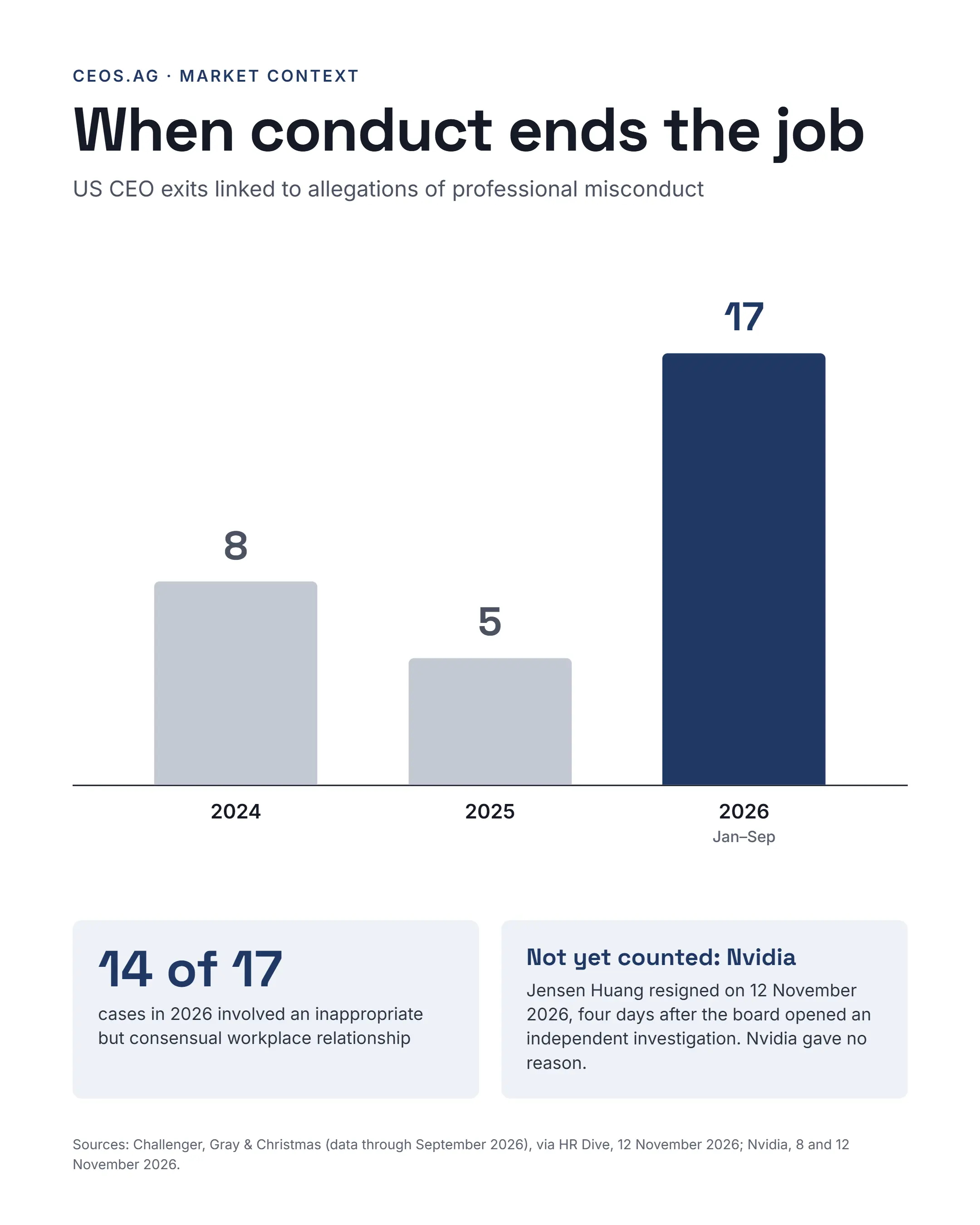
- CEO exits linked to misconduct allegations rose to 17 through September 2026, up from 5 in 2025 (Challenger).
- Nvidia’s Jensen Huang resigned on 12 November 2026; CFO Colette Kress is interim CEO.
2025: The year of the rookie
Spencer Stuart’s annual analysis of the S&P 1500 counted 168 new chief executives in 2025, the highest number since 2010. The more striking finding was who got the job: 84 percent of the incoming class – 140 people – were taking on their first enterprise CEO role. Most of them came from within. Sixty percent of the new CEOs were internal promotions, and 48 percent had previously served as chief operating officer or president, up from 40 percent a year earlier.
Not every appointment looked planned. Nineteen new CEOs were drawn from their company’s own board, the most since 2020 – a pattern Spencer Stuart reads as a sign that some companies were not ready for succession. The share of women among new CEOs fell to 9 percent, down from 15 percent in 2024. The incoming leaders were also younger, averaging 54.4 years.
Spencer Stuart does not treat the rise of first-timers as a problem in itself. In the firm’s view, the right choice depends on the situation: an experienced CEO may be better suited to a turnaround or a company hit by scandal, while a talented first-time CEO is more likely to deliver higher performance over time.

2026: Boards press pause
This year, the mood has changed. According to the Global CEO Turnover Index by Russell Reynolds Associates, which tracks 13 major stock indices worldwide, 101 CEOs left their posts in the first half of 2026, down from 118 a year earlier. That is the lowest first-half figure in the index’s nine-year history.
In the S&P 500, departures fell from 36 to 30 and appointments from 37 to 32. Of those 32 new chief executives, 88 percent were internal candidates – the highest first-half share Russell Reynolds has recorded. Experience is back in demand, too: 11 of the 32 had previously led a public company, compared with 8 of 37 in the first half of 2025. Four of the new CEOs moved directly from the board into the top job. The first quarter had already signalled the turn: the share of first-time CEOs among new S&P 500 appointments dropped to 59 percent, from 75 percent a year earlier.
Challenger, Gray & Christmas, which tracks CEO changes across all US companies, including private firms and non-profits, sees the same trend. CEO exits in the first half of 2026 ran 26 percent below the previous year. September brought the lowest monthly count of 2026 and the lowest September figure since 2022. “After two years of elevated turnover, companies are prioritizing stability,” said Andy Challenger, the firm’s labor expert and chief revenue officer.
The price of a learning curve
Part of the explanation may lie in performance data. A Korn Ferry analysis published in March 2026 found that companies hiring a first-time CEO posted an average annual stock return of 16.3 percent, compared with 36.3 percent for companies that chose an experienced leader. CEOs promoted from within performed competitively, with stock price growth of about 20 percent, while first-time external hires showed the weakest results.
Korn Ferry itself urges caution. The study looks at one-year returns only, a period the firm itself considers generally too brief to show what a CEO really changes, and calls its findings “directional rather than predictive.” Read alongside Spencer Stuart’s long-term view, the message for boards is less a verdict on first-timers than a reminder that the first years in office carry real risk.
When stability is not a plan: the Nvidia case
The most consequential CEO change of the year came without warning. On 8 November, Nvidia’s board opened an independent investigation following reports that founder and CEO Jensen Huang had been the target of a foreign intelligence effort. According to The Washington Post, Huang had acknowledged to the board that he had been intimate with a business executive whom, as The New York Times reported, US intelligence had identified as gathering information for Beijing. The board said it had no reason to believe that national security or company secrets had been compromised. Nvidia’s shares closed 4.27 percent lower the following day.
Four days later, on 12 November, Nvidia announced that Huang had resigned as president, chief executive and board member, effective immediately. The company’s release gives no reason. Chief financial officer Colette Kress, with Nvidia since 2013, became interim CEO while keeping her finance role. Harvey C. Jones, former CEO and executive chairman of Synopsys, was named the company’s first-ever chair of the board. The search for a permanent successor includes internal and external candidates; no timeline has been set.
The case fits a broader pattern. Through September 2026 – before the Nvidia investigation became public – Challenger counted 17 CEO exits linked to allegations of professional misconduct, compared with 5 in all of 2025 and 8 in 2024. In 14 of those cases, the issue was an inappropriate but consensual workplace relationship.
Apple shows the other path
Apple offers the counter-example. In April 2026, the company announced a handover that its board had approved unanimously after what it called a long-term succession planning process. On 1 September, John Ternus, previously senior vice president of hardware engineering and a 25-year Apple veteran, became chief executive. Tim Cook moved into the newly created role of executive chairman and stayed close to the transition.
The contrast is instructive. At Apple, the outgoing CEO, a long-standing independent chairman and an internal successor had months to prepare. At Nvidia, the company appointed its first board chair only at the moment its founder left.
What boards are learning
The 2026 data suggests that US boards have drawn their conclusions from the turbulence of 2025: they want leaders who know the company and can deliver from day one. But the year also shows that succession planning matters most when nobody expects it to be needed. A strong bench of internal candidates, a functioning board structure and clear rules on executive conduct are no longer governance details – they are a matter of company value. Companies don’t make decisions. People do. And the people at the top are being chosen with more care than a year ago.
A note on the data The three data sets cover different groups of companies. Spencer Stuart analyses the S&P 1500. Russell Reynolds tracks 13 major indices worldwide, including the S&P 500. Challenger counts CEO changes at all US companies, including private firms, government bodies and non-profits. The figures are therefore not directly comparable, but they point in the same direction.

